
Sources reviewed September 5, 2026 · Editorial Policy
Paying off several debts can feel confusing. Should you start with the smallest balance or the highest interest rate?
The debt snowball targets the smallest balance. The debt avalanche targets the highest interest rate. Both keep minimum payments current and focus extra money on one debt at a time.
The avalanche normally reduces interest costs. The snowball provides faster visible wins. The right method is the one that protects your required payments and that you can follow consistently.
Practice the method
Compare avalanche and snowball order
Enter sample balances and APRs to see how the two repayment-priority methods sort the same debts.
Educational tool. Results depend on the assumptions entered and are not personalized financial advice.
First, build a safe starting point
Before choosing a repayment order:
- List every debt, balance, interest rate, minimum payment, and due date.
- Keep essential costs such as housing, food, utilities, and necessary healthcare covered.
- Make at least the required payment on every debt.
- Stop adding new balances where possible.
- Keep a reasonable emergency buffer so one unexpected expense does not immediately create more debt.
If you cannot afford the minimum payments, choosing between snowball and avalanche is not the first problem to solve. Contact your creditors promptly, explain what you can afford, and ask about hardship or payment-plan options. The CFPB recommends contacting a credit-card company as soon as payment difficulty becomes clear.
How the debt avalanche works
The avalanche targets the debt with the highest interest rate first.
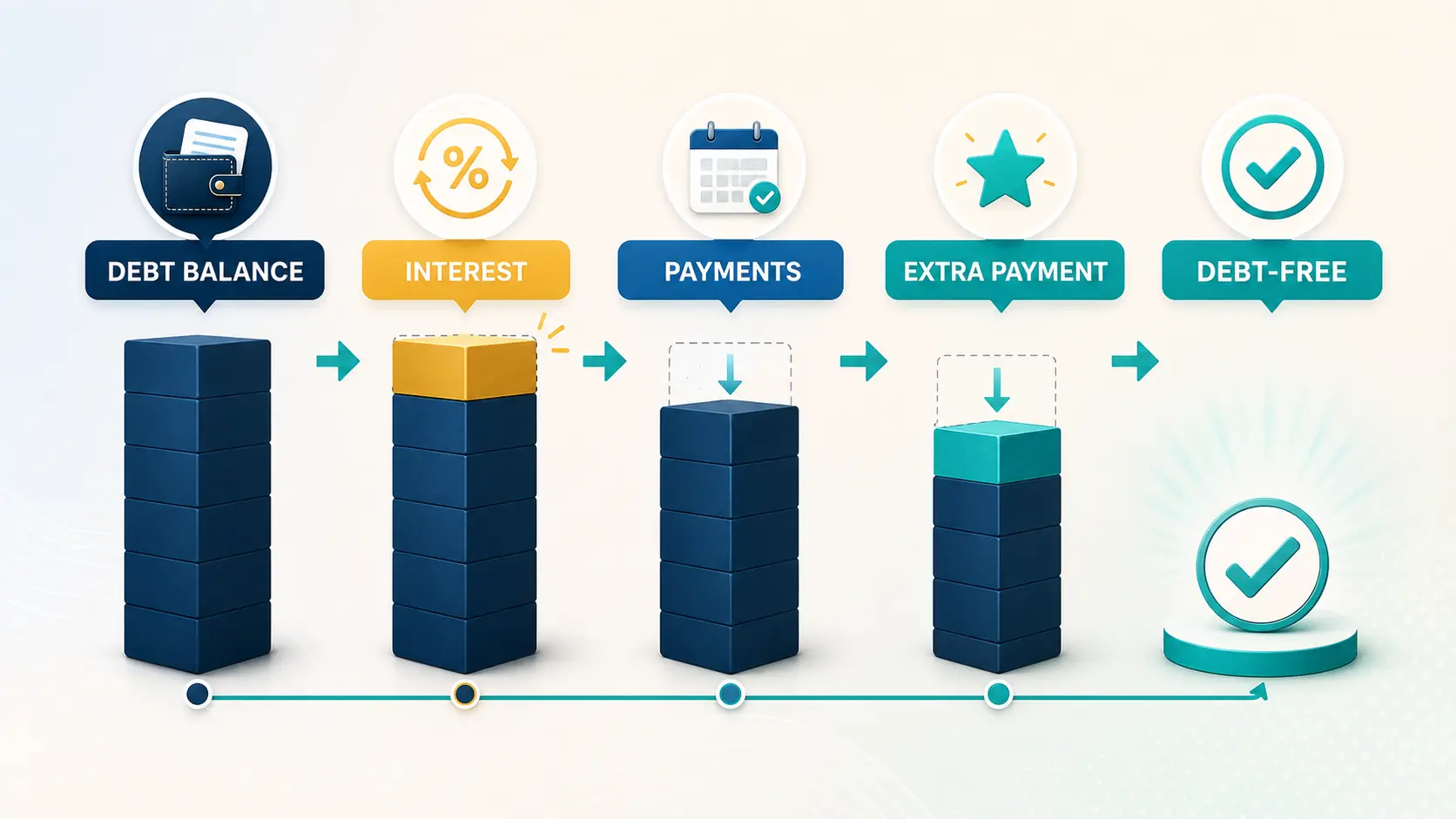
You make minimum payments on every debt, then direct all available extra money toward the highest-rate balance. When that debt is cleared, its payment rolls into the debt with the next-highest rate.
For example, your priority might be:
- Credit card at 24%
- Credit card at 18%
- Personal loan at 9%
The CFPB describes this approach as eliminating the costliest debt first, which can save money over the complete repayment period.
Main advantage: It usually minimizes interest when all other assumptions remain equal.
Possible difficulty: Your most expensive debt may also be large. Progress can feel slow before the first account disappears.
How the debt snowball works
The snowball targets the debt with the smallest balance first, regardless of its interest rate.
You continue paying the minimum on every account while directing extra money toward the smallest balance. After clearing it, you roll its entire payment into the next-smallest debt.
The priority might therefore be:
- $1,200 balance
- $3,000 balance
- $5,000 balance
Main advantage: Clearing an account sooner can create motivation and simplify your monthly obligations.
Possible difficulty: If larger debts carry much higher rates, the snowball can cost more interest.
Small wins can help some people stay motivated. That does not make the snowball cheaper, but it can make the plan easier to follow.
Worked comparison
Assume you have these debts:
| Debt | Balance | APR | Minimum payment |
|---|---|---|---|
| Card A | $1,200 | 18% | $40 |
| Card B | $3,000 | 24% | $90 |
| Loan C | $5,000 | 9% | $110 |
Your total monthly debt budget is $600. After the initial $240 of minimum payments, the remaining amount goes to the priority debt. Each cleared payment is rolled forward.
Using simplified monthly-interest calculations:
| Method | First debt cleared | First win | Estimated payoff time | Estimated interest |
|---|---|---|---|---|
| Avalanche | Card B at 24% | Month 8 | 17 months | About $866 |
| Snowball | Card A at 18% | Month 4 | 17 months | About $908 |
Both methods finish in month 17 in this example. The avalanche saves about $42 in interest, while the snowball clears the first account about four months sooner.
These are estimates, not lender quotes. They assume fixed rates and payments, no fees or new purchases, and monthly interest. Real balances and minimum payments may change.
How to choose
The avalanche may suit you if:
- Reducing total interest is your main objective.
- You can stay consistent without an early payoff.
- Your highest-rate debt is considerably more expensive than the others.
- You already track payments reliably.
The snowball may suit you if:
- Previous repayment plans have been difficult to maintain.
- Closing one small balance would simplify your finances.
- Early progress helps you remain motivated.
- The interest-rate differences between debts are relatively small.
A hybrid approach is also possible. You could clear one very small balance for an early win, then switch to the highest-interest debt. The important point is to define the rule before starting so that extra payments are not repeatedly redirected.
Three mistakes to avoid
1. Spreading extra money across every debt
Dividing a small extra payment between several accounts often delays visible progress. Concentrating it on one target gives the plan a clear direction.
2. Looking only at the monthly payment
A consolidation or refinancing offer may reduce the monthly bill by extending the repayment period. Compare the APR, fees, repayment term, total cost, and whether the rate can change.
3. Trusting guaranteed debt-relief promises
Debt-settlement companies may charge large fees and tell you to stop paying creditors. That can add fees and collection risk. The FTC warns about upfront charges, guaranteed settlements, and unexpected requests for sensitive financial details.
Your five-step repayment plan
- Complete your debt list.
- Choose avalanche, snowball, or a clearly defined hybrid.
- Automate every required minimum payment where appropriate.
- Direct all planned extra money toward one target.
- Review the tracker once a month and roll each cleared payment forward.
Do not judge the plan by one difficult month. Judge whether balances are moving in the intended direction and whether you are avoiding new high-cost debt.
Take the next step
Use Finlitera’s free Debt Repayment Tracker to list balances, rates, minimum payments, due dates, and repayment priorities.
For the underlying concepts, continue with the Debt lesson.
Official Sources
- Consumer Financial Protection Bureau: How to reduce your debt
- CFPB: Understanding minimum-payment repayment estimates
- Journal of Marketing Research: Small victories and debt reduction
- CFPB: Credit counseling, settlement, consolidation, and repair
- Federal Trade Commission: How to avoid debt-relief scams
Finlitera provides general financial education, not personal financial, legal, or debt advice. Rates, contracts, collection rules, and consumer protections vary by country. Check your agreements and use official local sources or a qualified professional for decisions specific to your situation.